 JOYPACK
How to specify a corrugated box
Inside dimensions, style, flute, wall and strength each answer a simple question about your product. Here is what the terms on a box quote mean, and how to choose.
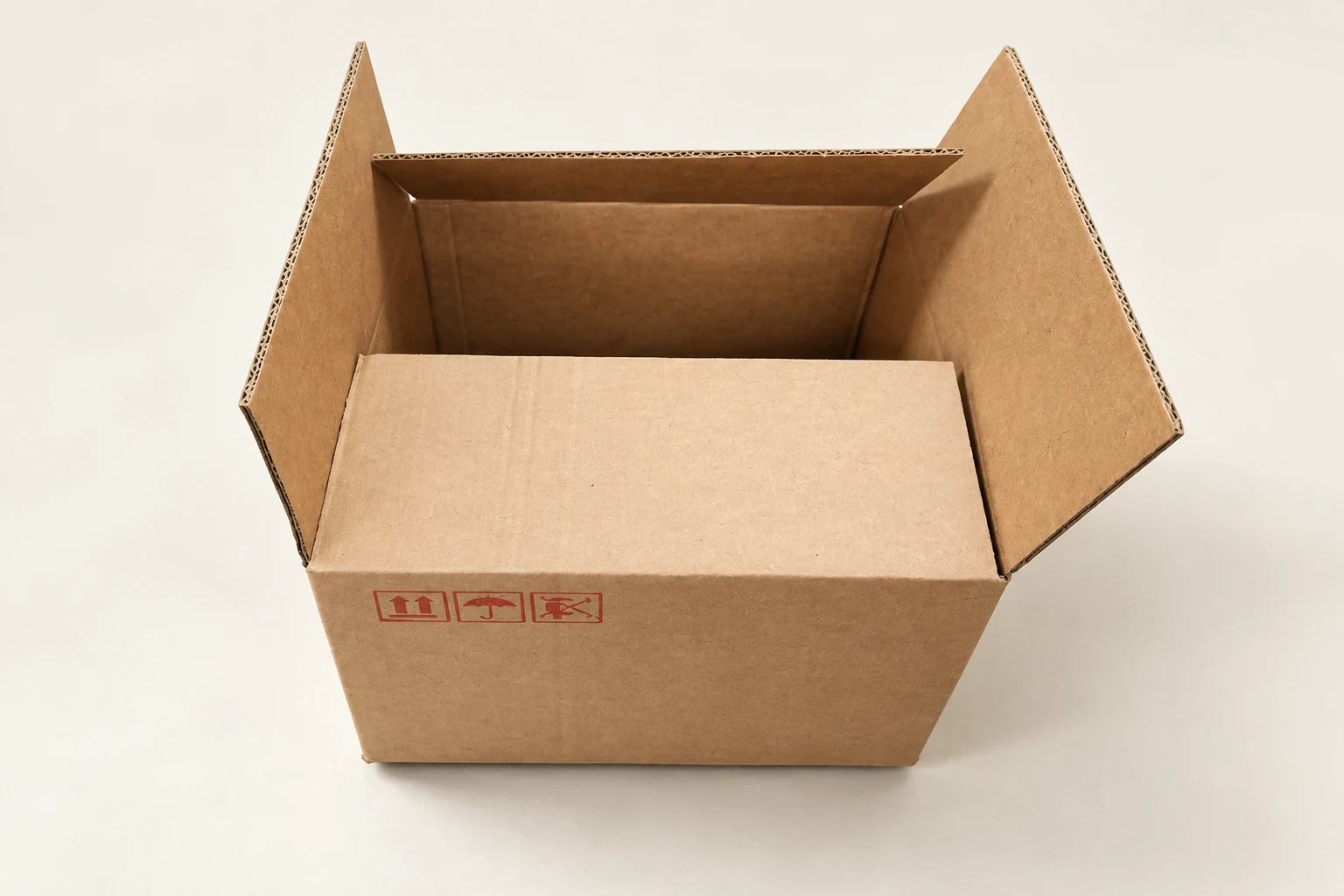
How to measure a box
Measure the inside, and give the dimensions in the order length × width × depth.
- Length — the longer side of the opening.
- Width — the shorter side of the opening.
- Depth — the height from the opening to the bottom.
Inside dimensions are what your product needs. The outside of the box is larger by the thickness of the board, so a box ordered by its outside size can end up too small.
Allow a little clearance so the product packs easily. How much depends on the product and any inner packaging.
Common box styles
The style is how the box is cut and closed. It decides how the box packs, stacks and opens.
- Regular slotted carton (RSC) — four flaps of equal depth; the outer flaps meet at the center. The everyday shipping box.
- Full overlap (FOL) — the outer flaps overlap across the full width, doubling the board at top and bottom. Used for heavier products.
- Box and lid — a body with a separate lid, for products loaded and removed from the top.
- Tube and cap — a sleeve with separate caps; the sleeve slides over the product.
Flute sizes
The flute is the wave-shaped layer between the flat liners. Larger flutes cushion and stack better; smaller flutes fold tighter and print more cleanly.
| FLUTE | APPROX. THICKNESS | OFTEN USED FOR |
|---|---|---|
| A | 4.8 mm (3/16 in) | Cushioning; less common today |
| C | 4.0 mm (5/32 in) | General shipping boxes; the most common single-wall flute |
| B | 3.2 mm (1/8 in) | Die-cut boxes, inserts and partitions; a flat surface for printing |
| E | 1.6 mm (1/16 in) | Smaller boxes where a thin wall and fine printing matter |
| F | 0.8 mm (1/32 in) | Small retail packaging |
| BC | 6.4 mm (1/4 in) | Double wall for heavier contents and taller stacks |
Thickness varies by mill and paper weight. Ask which flute suits your product; the board is confirmed on your quote.
Single wall or double wall
Single wall has one fluted layer between two liners. Double wall has two fluted layers and three liners.
Double wall adds stacking strength and puncture resistance for heavier products or taller stacks, at the cost of extra thickness and weight. Most everyday shipping boxes are single wall.
ECT or burst: how box strength is rated
ECT measures how well the board resists crushing on its edge, which predicts stacking strength. Burst measures the pressure it takes to rupture the board.
- Edge Crush Test (ECT) — a strip of board is compressed on its edge (TAPPI T 811), rated in pounds per inch, for example 32 ECT. It is the rating most shipping boxes use today, because stacking is the usual load.
- Burst (Mullen) test — pressure is applied until the board ruptures (TAPPI T 810), rated in pounds per square inch, for example 200#. It relates to rough handling and sharp contents.
| WALL | ECT | BURST | MAX. BOX + CONTENTS |
|---|---|---|---|
| Single | 32 ECT | 200# | 65 lb |
| Single | 44 ECT | 275# | 95 lb |
| Double | 48 ECT | 275# | 100 lb |
A box maker’s certificate printed on a bottom flap states which test the board meets, the size and gross weight limits, and the box maker.
Pairs and weight limits as listed in the carrier classification tables (NMFC Item 222, UFC Rule 41). They are reference pairs, not conversions between the two tests.
Specifying partitions and inserts
For a divided box, specify the space each part needs, the number of cells or positions, and the height.
Partitions divide a box into equal cells; inserts are cut to the shape of the product. Both can be made with the carton.
What to send us
- Product or part dimensions, or a sample
- Box inside dimensions (L × W × D), or the carton you use now
- Number of cells or positions, if the box is divided
- Weight per box and how boxes are stacked and shipped
- Printing, if any: colors and artwork
- Quantity per order and how often you reorder
- Delivery location